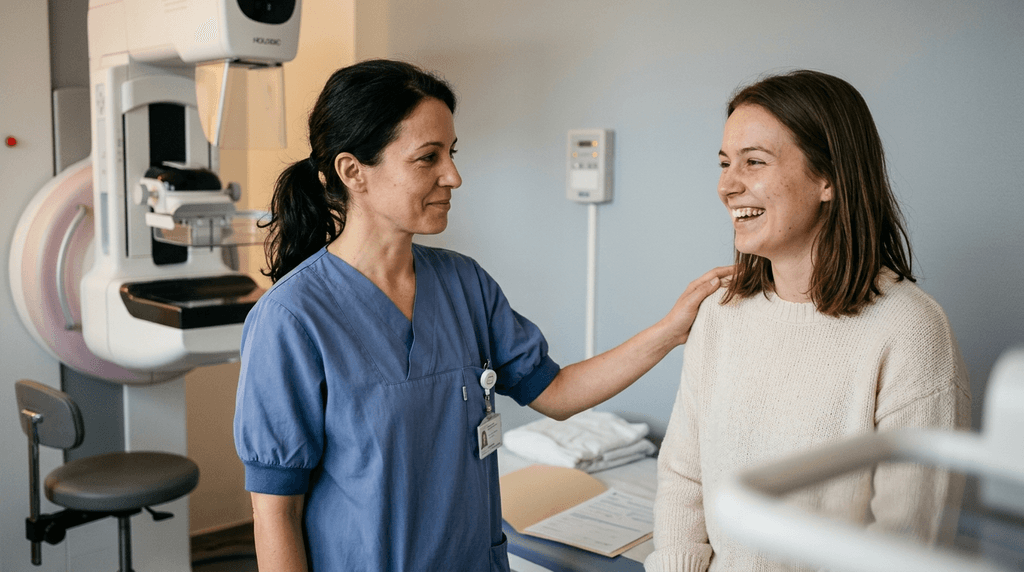
Sometimes it isn't the big studies that teach you something new about your own profession. Sometimes it's a laugh in a perfectly ordinary exam room. Today a young patient reminded me how much breast care has to do with people.
It was an ordinary morning. A young woman came in for a mammogram. She's in the middle of treatment that nobody her age expects to face. She could have been quiet. Withdrawn and careful. Instead she was loud in a beautiful way. She talked and laughed and asked questions. When we got to the subject of education and awareness, her voice suddenly filled with energy.
A young patient who is working to make sure more women her age know what prevention actually means. Who speaks openly about her experience. Because somewhere there might be another young woman going through the same thing right now and talking to no one about it. On a totally normal morning, she gave me something I hadn't expected.
Research keeps moving forward
Today SRF published an article showing how far breast cancer research has come. New study results from Chicago show that a genetic test can spare more and more patients from chemotherapy. It predicts precisely who really gains added safety from extra treatment. Striking data. It affects the most common form of breast cancer.
Steps like these matter. They reduce the physical toll. They protect quality of life. They give patients a basis for decisions that didn't exist ten years ago. Science is getting more refined and more gentle. That's very good news for women.
People need people
What made my patient so strong this morning wasn't a reference to a new test. It was the encounter in the room. The conversation. The eye contact. The moment when someone listens instead of just working through a list.
The two belong together. Research and human support aren't an either or. They carry each other.
What I see in the clinic
In over twelve years as a radiology technologist, I've seen how differently women approach breast care. Some come in like clockwork. Others put the appointment off until they can't anymore. Still others sit in the waiting room with no one to talk to beforehand. And sometimes someone like today is sitting in front of me. In the middle of a hard stretch and still with the energy to reach others.
What connects them all isn't primarily the wish for the newest test. It's the wish for guidance. Who's going to explain to me what's happening here? Who listens when I'm scared? Who helps me ask the right questions?
In Switzerland today, that kind of guidance is often a matter of luck. We have excellent breast centers. We have research at the highest level. What's missing more often is the calm, personal support in between. The time between appointments. The information before the diagnosis comes. The low-barrier place to ask a question.
Why I'm building Radiosa
With Radiosa I'm working on exactly that piece. Not because technology should replace the clinic. But because it can create room between the waiting room and the results, room that everyday clinic life often doesn't have. Women should understand what prevention means before they reach a difficult point. They should know their own bodies. They should know who to turn to if they notice something. And they should feel seen.
Research will keep taking its steps. As a clinician, I value those steps a lot. What I want to build alongside them are steps in support. So that what science makes possible actually reaches women.
What stays with me
Today's patient didn't show me a scientific breakthrough. She showed me something else. That an open and curious woman can be a teacher at any age. Even for her own doctors. And that breast care is more than images and findings. It's also the way we meet one another.
"Research creates new possibilities. Human support makes sure they actually arrive. We need both."
That's exactly where I want to keep working.
Recommended reading
- SRF Wissen: Treating breast cancer, a genetic test could spare even more people from chemotherapy, June 2, 2026. Read the SRF article