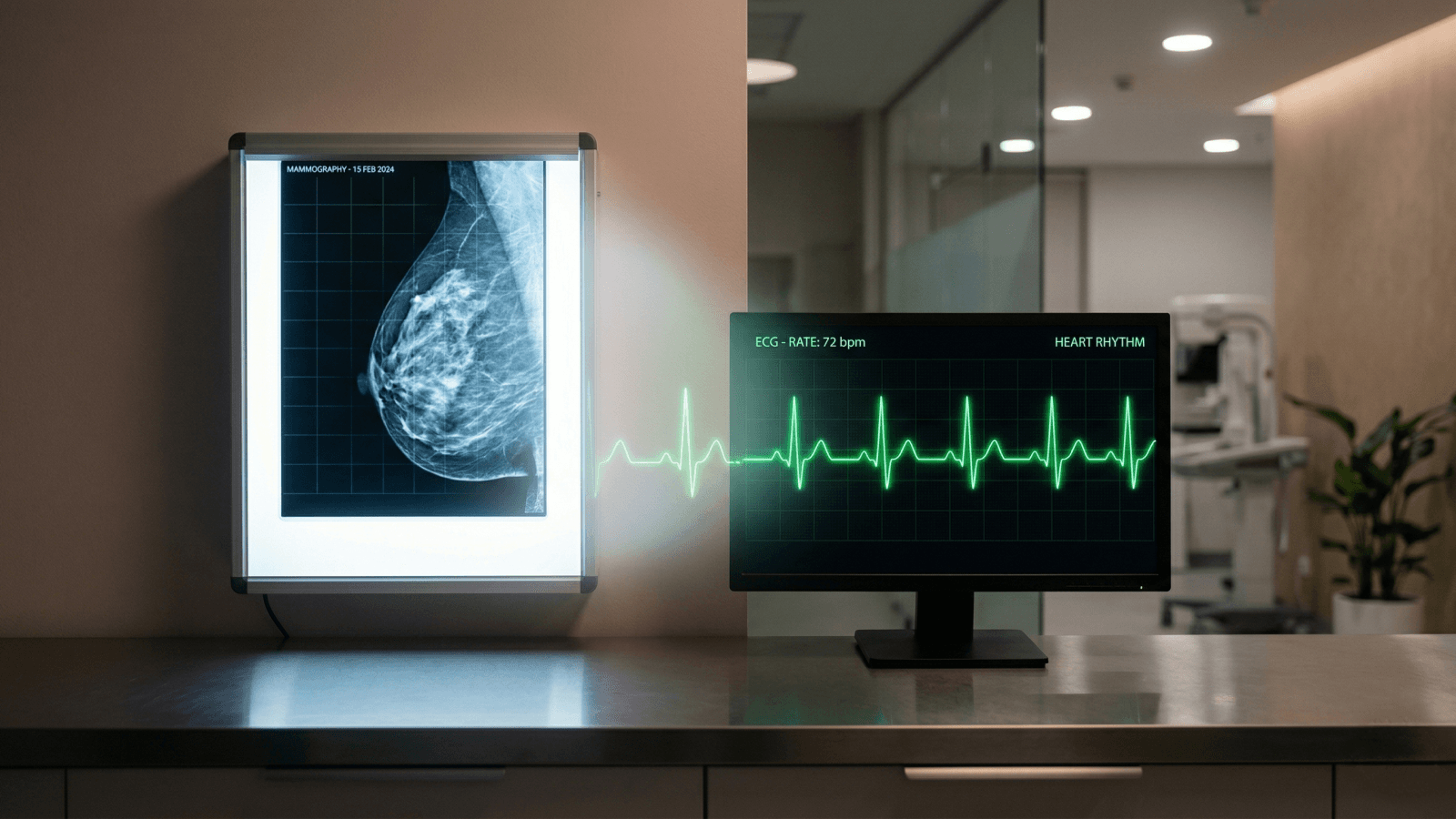
A new article in the Tages-Anzeiger raises a fascinating question: Can breast cancer screening even prevent heart attacks? We put it in context, what it means for women of every age, and why early detection is not a luxury.
Every year, around 6,500 women in Switzerland are diagnosed with breast cancer. About 1,500 die from it each year. And yet: those who catch it early and act early have far better chances.
Breast cancer is the most common cancer in women. But in many cases it is curable when it is found in time. That is exactly the goal of a mammogram: to make changes in the breast tissue visible before a tumor can be felt or causes symptoms.
The Tages-Anzeiger recently reported on a fascinating new perspective on mammography screening: regular screening might not only protect against death from breast cancer, but, through the effect of closer overall medical care, could possibly also help prevent heart attacks. This has not yet been conclusively proven scientifically, but it opens up an important new discussion: What does screening really achieve, and for whom?
6,500
women newly diagnosed each year in Switzerland (Tages-Anzeiger / Krebsliga Schweiz)
4 out of 1,000
women are saved from death by breast cancer thanks to screening (Prof. Passweg, USB Basel, via Tages-Anzeiger)
What a mammogram can really do
The mammogram is the most important available exam for early detection of breast cancer. It can make tumors visible before they can be felt, and the earlier a carcinoma is found, the better the chances of a cure and the gentler the possible treatments.
According to Germany's Federal Office for Radiation Protection, which in 2025 published one of the largest studies ever conducted on the subject, breast cancer mortality was 20 to 30 percent lower among women who took part in screening regularly than among those who did not.
Switzerland: 15 cantons with a program, and many without
In Switzerland, 15 cantons have organized screening programs that invite women aged 50 and over to a mammogram every two years, with the exam exempt from the deductible. Data from the canton of St. Gallen show that, thanks to screening, far more tumors were found at an early stage, which helped prevent many mastectomies.
In cantons without such programs, the picture is different: a study by the University of Lucerne shows that larger tumors are diagnosed more often there, with correspondingly poorer chances of a cure.
"Around 6,500 women in Switzerland are diagnosed with breast cancer every year. About 1,500 die each year from the effects of the disease." Simone Steiner / Markus Brotschi, Tages-Anzeiger editorial team
What about younger women?
The official screening programs in Switzerland are aimed at women aged 50 and over. But breast cancer does not only affect older women. One in five diagnoses in Switzerland involves a woman under 50.
For younger women without special risk factors, current medical guidance does not recommend routine mammograms, in part because denser breast tissue makes them harder to read and the radiation risk has to be weighed carefully. But that does not mean there are no options.
In March 2026, Germany expanded the radiation protection approval for mammography to include women aged 45 and over, after studies showed that the benefit outweighs the risks in this age group as well. In Switzerland, similar adjustments are being discussed.
For younger women with a family history or a genetically elevated risk, special intensified early detection programs already exist today, using ultrasound or MRI, which are radiation-free and are often more informative than a standard mammogram when tissue is dense.
Radiosa recommends: Talk about your personal breast cancer risk at your next gynecology appointment. Is there breast cancer in your family? Do you have questions about mammograms? These conversations matter, and you have the right to make an informed decision.
What this could mean for screening (without the polemics)
The Tages-Anzeiger article brings up a fascinating additional question: Could regular participation in screening also have a "combo effect" — that is, not just earlier tumor detection, but also more medical attention overall (for example, blood pressure, diabetes, cardiovascular risks), because women are in contact with the health care system more often?
Important: this is plausible as a hypothesis, but it is not the same as saying "mammograms prevent heart attacks." It points more to the idea that screening programs are often a chance for holistic prevention.
Should the age for screening programs be adjusted?
The question is being discussed internationally, and it cannot be answered with a simple yes or no. What matters are the benefits and possible drawbacks in each age group.
- For women aged 45–49, depending on risk, it may make sense to make access to structured early detection easier (for example, informed decision-making, clear quality standards, and possibly a risk-based approach).
- For younger women, assessment is more difficult (often denser breast tissue, more false alarms and follow-up exams). At the same time, there are groups that could benefit especially (family history, genetic risks, very high breast density).
A pragmatic approach
Instead of "one size fits all," the next step could be:
- Earlier and better counseling (from age 40/45): risk, family history, breast density, symptoms.
- A risk-based approach to which imaging makes sense and when (mammogram, ultrasound, MRI).
- Thinking of screening as a combined offering: breast health plus a cardiovascular check and lifestyle prevention, so the benefit reaches beyond any single disease.
Did you know? A study by the University of Lucerne, the Lucerne Cantonal Hospital, and the Hirslanden Klinik St. Anna analyzed 21,518 breast cancer cases from across Switzerland: in cantons without a screening program, larger tumors were diagnosed more often, with poorer chances of a cure.
About the study: Breast cancer in Switzerland: a comparison between organized-screening versus opportunistic-screening cantons
Gutzeit A., Diebold J. et al., ESMO Open, Volume 9, Issue 10, October 2024
What you can do now
- Check whether your canton offers a screening program: Vorsorge-Check and www.swisscancerscreening.ch
- At your next appointment, talk with your gynecologist about your personal risk.
- Learn more about self-examination and the signs you should know: soon Radiosa will expand the Vorsorge-Check with tips on self-examination.
- If you have a family history: actively ask about intensified early detection, possible from age 40.
- Examine your breasts yourself on a regular basis, not as a substitute, but as a complementary habit. You will find plenty of information on self-examination, risk factors, and the screening options in Switzerland in the Radiosa Vorsorge-Check, simple, easy to understand, and tailored to you.
Sources & further information
All quotes in this article include a source reference.
- Tages-Anzeiger: "Mammografie: Wie Brustkrebs-Screening Herzinfarkte verhindert" (referenced, behind paywall)
- Tages-Anzeiger: "Schaffhausen sistiert Mammografie-Screening," Steiner / Brotschi, July 17, 2025
- Tages-Anzeiger: "Krebs-Vorsorge: Wann soll man zu Darmspiegelung und Mammografie?," April 2024/2025
- Bundesamt für Strahlenschutz (BfS): press release on mammography screening, July 9, 2025, bfs.de
- University of Lucerne / LUKS / Hirslanden: Gutzeit et al., ESMO Open, October 2024, luks.ch
- SRF News: "Kanton Schaffhausen führt Brustkrebsprogramm vorläufig nicht ein," July 16, 2025
- Krebsliga Schweiz: www.krebsliga.ch/ueber-krebs/frueherkennung/brustkrebs
- Swiss Cancer Screening: www.swisscancerscreening.ch
- PINK CUBE Test Your Breast: www.pinkcube-testyourbreast.ch